

Tel: 86 13941724528
Contact: Jin Feng
Tel: 86 13941732978
Contact: Jin Bing
Address: Guantun Town, Dashiqiao City, Yingkou City, Liaoning Province
At present, the total annual output of dead-burned magnesia in China is 4 to 4.5 million tons. Following industry practice, sintered magnesia can be broadly divided into dead-burned magnesia,medium-grade magnesia,high-purity magnesia.
Before the 1980s, for more than 30 years, the national production of sintered magnesia was mainly undertaken by the former Angang Dashiqiao Magnesite Mine. Shaft kilns of 25 m³, 32 m³, 40 m³, 47 m³, and 55 m³ were successively used, with coke as fuel and lump magnesite as raw material. Dead-burned magnesia with an MgO content of 92% was produced by one-step calcination and manual discharge, providing raw material for bricks used in open-hearth steelmaking furnaces nationwide.
The defects of this process are: low ore utilization rate, as fine ore particles cannot be used; high impurity content, as ash in coke pollutes the magnesia, increasing the SiO2 and Al2O3 contents, with the maximum MgO content only guaranteed at 92%; poor continuous operability, as large lump magnesite decomposes upon heating to produce fine particles that adhere to the kiln wall, and the material in the kiln is prone to "balling," all of which cause frequent changes in the material flow and thermal regime in the kiln, leading to shutdown accidents and making mechanized operation impossible; low density of the magnesia, as magnesite decomposes in the preheating zone of the kiln, releasing CO2 to become light-burned MgO, but its MgCO3 "mother salt pseudomorph" still remains, which is not conducive to further densification of the magnesia, with the bulk density of sintered magnesia only between 3.0 g/cm³ and 3.1 g/cm³; severe environmental pollution, as magnesite decomposition releases large amounts of CO2 and the combustion flue gas carries fine coke particles and light-burned dust out of the kiln, polluting the environment, and high-temperature flue gas is difficult to treat.
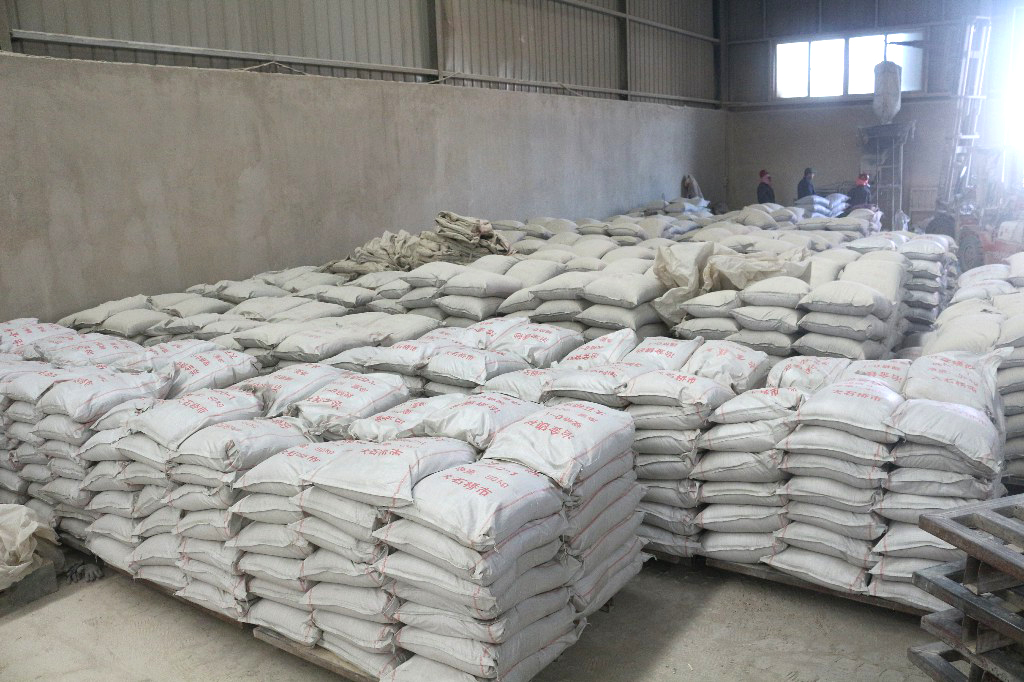
At present, dead-burned magnesia in China is still calcined from second- and third-grade ore in solid-fuel shaft kilns, with an MgO content of 90% to 92% and a bulk density above 3.10 g/cm³. Dead-burned magnesia is the main raw material for producing ordinary magnesia fired bricks and monolithic refractories. The current annual output in Liaoning Province is estimated at 2.5 million tons; since third-grade ore can be used, the product price is low and it has a market, so it is difficult to eliminate at present.

Service Hotline86-13941724528
Contact: Jin Feng Phone: 86 13941732978
Address: Guantun Town, Dashiqiao City,
Yingkou City, Liaoning Province Contact: Jin Bing
